Vovka the sniper's death in a mine explosion
Grey BeesVovka the sniper’s death in a mine explosion is a wartime episode in which a brief report becomes a difficult act of recovery and a lasting element of Sergey Sergeyich’s private reckoning with the dead. Pashka identifies the sniper as Vladlen, a man from Omsk, and explains that a mine beneath his position killed him overnight. At the crater left by the blast, Sergeyich helps gather remains; later, he remembers Vovka with other soldiers whose deaths expose the cost of war and the uncertain boundaries of responsibility.
Identity and Circumstances
Vovka is the sniper’s familiar name; Vladlen is his call sign, while Vovka is his actual name. Pashka supplies this clarification when Sergey Sergeyich asks who the dead sniper was, adding that he came from Omsk. This exchange gives the casualty a name and a place of origin, but little biography: Sergey Sergeyich does not appear to have known him personally.
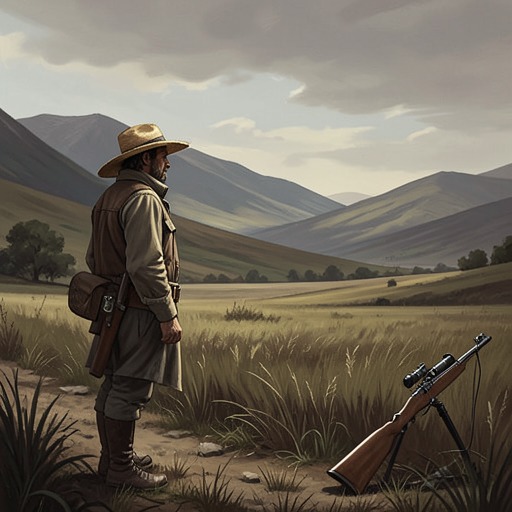
Pashka says that Vovka was killed when a mine was placed beneath his position. The sniper had lain down there the previous night, and the mine then detonated. The account rules out a direct hit and locates the cause in an explosive set under the position, making the death an ambush rather than the result of a visible exchange of fire.
The Crater and the Recovery
Five minutes after Pashka tells him what happened, Sergey Sergeyich reaches the car outside the Krupins’ gate. Camouflaged men are in the yard, distributing black bags for collecting remains. Pashka takes a bag and goes toward the back of the house; Sergey Sergeyich looks over his own and remarks that it seems small. The men tell him to fill it and promise another if needed.
The sniper’s position has become a crater at least a metre deep, with the surrounding earth churned and scattered. Sergey Sergeyich sees human remains near the orchard, then finds an ear on the ground as he moves away from the crater. He looks at his clean hands and hesitates to touch it. Instead, he first picks up a lump of earth, then uses his dirtied fingers to put the ear into the bag. When the driver calls for him to hurry, he adds several lumps of earth so the bag will not appear nearly empty. The small gestures make collection both practical and unsettling: he participates in the recovery, but the bag’s contents cannot restore the person who has been lost.
Memory Among the War Dead
Vovka’s death returns later in Sergey Sergeyich’s thoughts as he tries to mourn a different fallen soldier, Samoylenko, whom he knows only as a man killed in Donbas. His attention keeps shifting among the dead: Petro, a soldier who had entered his home carrying a grenade; the soldier with an earring who lay dead in a field for half the winter, with neither side willing to retrieve and bury him; and the sniper from Omsk, whose position had been on the edge of the Krupins’ garden.
The recollection places Vovka’s death within a wider pattern of deaths and neglected burial. Sergey Sergeyich’s mind moves from one soldier to another rather than settling neatly on the person he means to commemorate. Vovka is therefore remembered not through a personal history but through the crater, the recovery bag, and the proximity of his battle position to an ordinary garden.
Public Accounts and Narrative Significance
Elsewhere, television and an attempted border interview show how public descriptions of the conflict are disputed and managed. On television, three men discuss why the country has not fallen apart, attributing its survival to American and European support for Ukrainians. Another channel shows a woman with green dye on her face asserting her right to express an opinion. These broadcasts do not establish the circumstances of Vovka’s death, but they form part of the media environment surrounding Sergey Sergeyich’s experience of war.
When an interviewer asks why he came from Donbas, Sergey Sergeyich says that he is from the grey zone, where people are shooting, and describes Ukrainians on one side and Russians on the other. A young man stops him and tells him to repeat the account without saying “Russians,” redirecting him toward the word “separatists.” The intervention makes the naming of combatants a point of pressure: the spoken account is edited even as Sergey Sergeyich tries to explain the violence that has displaced him. Against those competing public narratives, the episode of Vovka’s death is presented through a stark sequence of reported cause, damaged ground, and the labor of gathering remains. It shows how a battlefield death persists not only as news, but as an obligation the living carry into later acts of mourning.